
Blog
China Top 10 Ceramic Tempered Glass Manufacturers?
Ceramic Tempered Glass combines a fired ceramic design with heat-strengthened safety glass. It appears in shower enclosures, kitchen panels, façades, and appliance doors, where printed patterns must endure daily cleaning and temperature changes. But product quality is not captured by a catalogue image. Buyers should compare glass thickness, edge finishing, ceramic frit coverage, heat-treatment controls, and test documentation.
The demand backdrop is substantial, though not specific to ceramic-printed glass. The IEA and GlobalABC’s 2023 Global Status Report for Buildings and Construction states that buildings and construction accounted for about 34% of global energy demand and 37% of energy- and process-related CO₂ emissions in 2022. Fortune Business Insights’ tempered-glass market analysis also tracks demand across major end-use sectors, including construction and automotive. These reports help explain the wider market; they do not verify any individual supplier’s performance. That distinction matters.
This guide examines ten manufacturers with attention to production capability, customization, quality systems, export experience, and application fit. A supplier’s technical answers may be more useful than its headline capacity. Ask for representative samples, test records, minimum order quantities, and lead-time estimates. Check how the ceramic pattern looks at the edge, not only under showroom lighting. Rankings have limits. Company information changes, and public data can be incomplete. Use the list as a starting point, then confirm specifications directly with each manufacturer.
What Ceramic Tempered Glass Is and How It Is Used
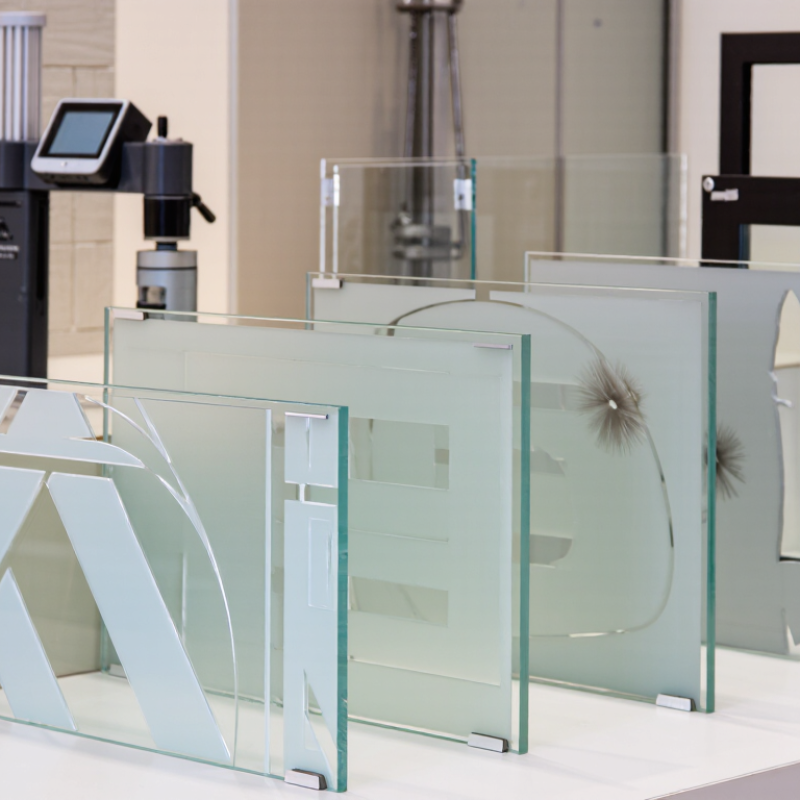
Ceramic tempered glass starts as flat glass printed with ceramic frit, a mineral-based ink. During heating, the frit fuses to the surface as the glass is tempered. The result can have solid colors, dots, lines, or custom patterns. It can obscure views while still letting light through. That matters in bright spaces.
Tempering improves resistance to impact and heat compared with untempered glass, though it does not make glass unbreakable. If broken, it usually crumbles into small pieces. Applications include building facades, shower screens, interior partitions, and appliance panels. Designers use it to add privacy, reduce glare, or create visual markers on clear doors. Performance depends on the glass thickness, finish, installation, and intended use. Details matter.
Tips: Confirm the pattern, color, dimensions, and edge treatments before production. Holes and cutouts usually need to be specified before tempering, since the finished panel cannot be cut afterward. Ask for test data for the exact product and application. A sample helps, but it may not perfectly match a large installed surface.
China’s Ceramic Tempered Glass Manufacturing Landscape
China’s ceramic tempered glass sector serves architectural, appliance, and interior-design projects, with production capabilities varying by region and factory. The term often describes glass decorated with ceramic frit before heat treatment. The printed pattern is fired onto the surface as the glass is tempered. This process can create durable colors, opaque areas, and precise borders. Small process changes matter.
Factories may differ in printing accuracy, furnace control, cutting capacity, and inspection routines. A clean print can still fail if edges chip during handling or holes sit slightly off position. Experienced manufacturers check dimensions, surface defects, and tempering quality across production batches. Yet quality is not always consistent between batches. That deserves attention.
For procurement teams, clear drawings and realistic tolerances help prevent avoidable rework. Ask for sample pieces, batch inspection records, and relevant test documentation before approving a large order. Check whether the supplier can explain its process, including how it controls color variation and breakage. Compare lead times and protective packaging, not just quoted prices.
Criteria for Evaluating Ceramic Tempered Glass Manufacturers
Choosing a ceramic tempered glass manufacturer requires more than comparing quoted prices. Start with the glass type, thickness range, panel dimensions, and expected heat exposure. Ask how the supplier controls ceramic ink coverage, firing conditions, and tempering uniformity. These factors affect color consistency, edge strength, and resistance to thermal stress. Small details matter. Request process records, not only a polished sample.
A reliable evaluation should include inspection methods and clear acceptance limits. Check flatness, dimensions, print defects, and edge chips under consistent lighting. For appliance panels, ask for relevant thermal cycling and impact test reports. Confirm that sample results can be traced to production batches through lot numbers and retained records. Ask for evidence. A certificate alone cannot show how each run was controlled.
Review production capacity, packaging, lead times, and change-control practices before approving a supplier. A trial order can reveal whether communication stays clear when drawings change or defects appear. When practical, observe handling between cutting, printing, and tempering. I would not treat a flawless sample as proof of stable output; it is only one snapshot. Some criteria are easy to score, while consistency across many batches takes time to verify.
China Top 10 Ceramic Tempered Glass Manufacturers? – Criteria for Evaluating Ceramic Tempered Glass Manufacturers
Use this weighted scorecard to compare suppliers consistently. It defines evaluation criteria, not a ranking of specific manufacturers. Request current, product-relevant evidence and verify certificates with the issuing organization where applicable.
| Evaluation criterion | Weight | Evidence to request and verify | Scoring guidance (0–5) |
|---|---|---|---|
| Product standards and compliance | 18% | Applicable test reports and declarations for the intended market, glass type, thickness, and use. Check report scope, sample details, test date, and issuing laboratory. | 5 = current, independently verifiable evidence covers the specified product; 0 = no relevant evidence. |
| Tempering process control | 14% | Documented control of heating and quenching parameters, furnace maintenance, inspection records, and procedures for handling process deviations. | 5 = controlled, recorded, and routinely reviewed; 0 = no documented controls. |
| Ceramic frit and print quality | 12% | Approved color and pattern samples, print-position tolerances, coverage limits, adhesion or durability test results, and inspection criteria for defects such as pinholes or uneven coverage. | 5 = agreed specifications are documented and supported by sample and inspection records; 0 = no defined acceptance criteria. |
| Dimensional and fabrication capability | 10% | Written capability limits for thickness, size, edgework, holes, notches, and shape; confirm tolerances against the drawing and intended application. | 5 = capabilities and tolerances match the project and are confirmed in writing; 0 = requirements cannot be confirmed. |
| Quality management system | 10% | Current quality-system certificate, if applicable, verified against its scope, site, validity dates, and certification body; also review incoming, in-process, and final inspection procedures. | 5 = relevant, valid system evidence plus documented inspections; 0 = no verifiable quality procedures. |
| Testing and inspection capability | 10% | Inspection plans, calibrated measuring equipment records, sample test reports, and access to competent internal or independent testing for specified requirements. | 5 = tests and inspection records are traceable to requirements and production lots; 0 = no meaningful test evidence. |
| Customization and engineering support | 8% | Drawing review, feasibility feedback, sample approval workflow, revision control, and written confirmation of special print, edge, or shape requirements. | 5 = responsive, documented engineering and sample-approval process; 0 = no defined process. |
| Batch traceability and corrective action | 6% | Lot identification linking finished goods to production and inspection records; documented complaint handling, root-cause analysis, and corrective-action follow-up. | 5 = traceability and corrective actions can be demonstrated; 0 = batches cannot be reliably identified. |
| Capacity and delivery planning | 6% | A production and shipping plan for the requested order, including stated lead time, packaging method, shipment milestones, and the supplier’s process for communicating delays. | 5 = feasible schedule with clear milestones and contingency communication; 0 = no credible delivery plan. |
| Environmental and workplace controls | 6% | Relevant, current environmental or workplace-system documentation where required; ask how glass waste, packaging, and production risks are managed. | 5 = applicable controls and evidence are documented and verifiable; 0 = no relevant information provided. |
| Total weighting | 100% | Weighted result = sum of (criterion rating ÷ 5 × criterion weight). | |
Rating scale: 0 = no evidence; 1 = very limited; 2 = partial; 3 = adequate; 4 = strong; 5 = strong, current, and independently verifiable. Confirm applicable requirements with the buyer, project specification, and relevant market regulations before placing an order.
Profiles of 10 Ceramic Tempered Glass Manufacturers in China
China’s ceramic tempered glass manufacturers differ less by brochure claims than by control of printing, tempering, and inspection. A useful set of ten profiles compares large-panel processors, custom-pattern specialists, façade suppliers, curved-glass workshops, laminated-glass lines, and smaller-batch producers. It also checks practical details: frit coverage near drilled holes, edge quality, color consistency, packing protection, and the documents supplied with each order. These details affect installation, not just appearance.
The International Energy Agency’s 2024 Global Status Report for Buildings and Construction estimates that buildings and construction accounted for 32% of global energy demand and 34% of energy- and process-related CO₂ emissions in 2022. That context makes verified glass specifications important, though ceramic printing alone does not prove energy savings. Ask each supplier for sample inspection records, tempering test results, and tolerances for dimensions and color. Small details matter. I would still verify production capacity against the buyer’s actual panel sizes; published capacity figures can be difficult to compare. The ten profiles are most useful as starting points for technical checks, not as an audited ranking.
China Ceramic Tempered Glass Manufacturers: 10 Profiles
The title covers 10 manufacturer profiles. Company-level performance data was not provided, so this chart shows only the number of profiles covered.
How to Compare Suppliers and Select the Right Manufacturer
When comparing ceramic tempered glass manufacturers in China, look beyond a polished sample. Ask how each factory controls glass thickness, edgework, ceramic ink application, and tempering. UNEP’s 2024 Global Status Report for Buildings and Construction estimates that buildings account for 32% of global energy use and 34% of energy-related CO₂ emissions. This makes verified performance and consistent production worth checking, especially for architectural projects.
Request recent, product-specific test reports, not certificates for unrelated glass. Check whether tests cover impact strength, fragmentation, coating adhesion, and dimensional tolerances. Ask for batch records and traceability from raw glass to finished panels. Small differences matter. A neat sample can still mislead. I would compare several panels under the same lighting, then inspect printed edges, color variation, and surface defects at close range.
Compare the full landed cost, including packaging, breakage allowances, lead time, and replacement terms. Ask suppliers to provide a pilot batch before placing a large order. Confirm that the test sample and production batch use the same materials and process settings. Factory audits can help, but they do not replace independent test results. I would also check how quickly the supplier responds to a technical question; this is useful evidence, though not proof of quality.