
Blog
2026 Best Fiberglass Windows for Global Buyers
Choosing the right fiberglass windows for international projects requires more than comparing frame colors and advertised prices. Climate, building codes, installation skills, glass performance, and long-term service all influence the result. A window that performs well in a cold Canadian suburb may need different glazing and drainage details in Singapore, Dubai, or coastal Australia.
Building scientist Dr. Joseph Lstiburek puts the challenge plainly: “Windows are holes in walls.” That simple sentence deserves attention. Every opening must resist wind, rain, heat transfer, and unwanted air movement. High-quality fiberglass windows can offer strong frames, stable dimensions, low maintenance, and reliable thermal performance. However, no frame fixes poor flashing or careless installation.
This guide evaluates the 2026 market from a global buyer’s perspective. It considers U-values, solar heat gain, air leakage, water resistance, hardware quality, warranty support, and regional availability. It also examines differences between pultruded fiberglass, hybrid frames, and competing materials. Real projects often reveal more than brochures. A narrow coastal window may face salt spray, while a large desert opening may endure intense sunlight and thermal movement.
Some rankings remain difficult.
Manufacturers publish different test methods, and installer quality varies widely. Therefore, readers should verify certifications, local compliance, replacement-part access, and independent test reports before ordering. Price matters, but so do shipping damage, lead times, and future repairs. The best fiberglass windows are not always the most expensive. They are the ones matched carefully to the building, climate, budget, and available workmanship. Mistakes still happen, even on premium projects. This overview aims to make those decisions clearer, more practical, and easier to question.
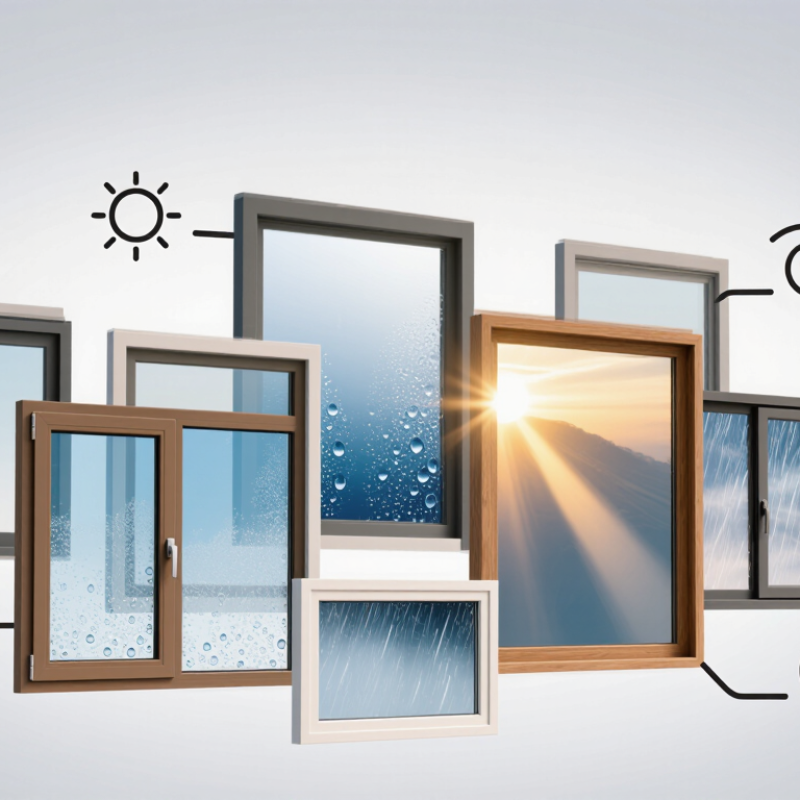
What Are Fiberglass Windows and How Do They Work?
Fiberglass windows combine glass fibers with resin to form a rigid frame. The manufacturing process often uses pultrusion, which pulls reinforced material through a heated die. This creates straight, strong profiles with consistent dimensions. Unlike metal, fiberglass transfers relatively little heat. The U.S. Department of Energy reports that windows can represent 25–30% of residential heating and cooling energy use. Frame design therefore matters.
A fiberglass window works as a complete system, not just a frame. The frame holds the insulating glass unit, weather seals, drainage paths, and hardware. Low-emissivity coatings reflect infrared heat, while argon-filled cavities reduce heat movement between panes. The National Fenestration Rating Council evaluates whole-window U-factor and solar heat gain coefficient. Lower U-factor usually means better insulation. Lower solar heat gain can help hot climates, but cold regions may benefit from useful winter sunlight.
The frame still expands and contracts. Fiberglass usually moves less than vinyl or aluminum, yet installation remains critical. The 2023 International Energy Conservation Code emphasizes tested performance and proper air sealing. I would not call any window maintenance-free. Poor flashing can cause water damage, even with an excellent frame. Buyers should compare certified thermal data, glass configuration, drainage details, and local climate needs. One weakness remains easy to miss: laboratory ratings cannot fully represent careless installation or shaded, windy buildings.
2026 Best Fiberglass Windows for Global Buyers - What Are Fiberglass Windows and How Do They Work?
A practical, brand-neutral comparison table for evaluating fiberglass window systems across different climates and building standards.
| Evaluation Dimension | Fiberglass Window Data | How It Works or Why It Matters | Global Buyer Benchmark |
|---|---|---|---|
| Basic Definition | A window with frames and sash components made primarily from glass-fiber-reinforced polymer, commonly called fiberglass or glass-reinforced plastic. | Fine glass fibers reinforce a polymer matrix, creating a rigid, dimensionally stable frame material. | Confirm that the frame, sash, and reinforcement are fiberglass-based rather than only fiberglass-colored or fiberglass-wrapped. |
| Frame Construction | Common manufacturing methods include pultrusion, molding, or a combination of structural fiberglass profiles and polymer components. | Continuous or aligned glass fibers improve strength and stiffness while the polymer protects the fibers from the surrounding environment. | Request section drawings, reinforcement details, corner construction, and product test documentation. |
| Thermal Conductivity | Typically about 0.3–0.4 W/m·K for fiberglass framing material, depending on formulation and construction. | Lower conductivity than metal frames reduces heat flow through the frame and helps limit interior surface temperature differences. | Evaluate the complete window U-factor, not frame material alone; glazing, spacers, seals, and frame geometry also affect performance. |
| Thermal Expansion | Approximately 5–6 × 10⁻⁶/K for many fiberglass composites, although values vary with fiber direction and formulation. | Expansion is relatively close to that of glass, helping reduce movement between the frame, glazing, and sealants during temperature changes. | Important for regions with hot summers, cold winters, high solar exposure, or large day-night temperature swings. |
| Energy Efficiency | High-performance units may achieve whole-window U-factors around 0.20–0.35 Btu/h·ft²·°F, or approximately 1.14–1.99 W/m²·K, depending on glazing and configuration. | A low-conductivity frame combined with insulated glazing reduces conductive heat transfer and heating or cooling demand. | Compare certified whole-window U-factor values under the target market’s standard, such as NFRC, EN, ISO, or local equivalent methods. |
| Glazing Compatibility | Compatible with double, triple, laminated, low-emissivity, solar-control, and acoustic insulating glass units when the frame system is designed for them. | The glass area is usually the largest part of a window, so glazing selection often has a greater effect on thermal and solar performance than the frame alone. | Specify glass thickness, cavity width, gas fill, low-emissivity coating, spacer type, and total glass U-factor. |
| Solar Heat Gain | Solar Heat Gain Coefficient, or SHGC, varies mainly with the selected glass and coating rather than the fiberglass frame. | Lower SHGC can reduce unwanted solar heat in hot climates; higher SHGC can provide useful passive solar heat in colder climates. | Choose the SHGC according to orientation and climate zone instead of selecting one value for every project. |
| Air Tightness | Performance depends on sash design, seals, drainage paths, corner joints, and installation. Certified high-performance units can achieve very low air leakage. | Tight seals reduce drafts, uncontrolled heat loss, dust entry, and moisture movement through gaps. | Request an independently tested air-leakage rating and installation instructions for the specific operating style. |
| Water Management | Fiberglass itself is not susceptible to rust and has low moisture absorption, but the full assembly still requires weep paths, gaskets, sealants, and proper flashing. | A water-managed design directs incidental water to the exterior instead of relying only on perimeter sealant. | Check water-penetration test results, sill drainage design, flashing requirements, and compatibility with local installation practices. |
| Structural Stability | Fiberglass composites offer high stiffness-to-weight performance and generally resist warping better than many conventional plastic profiles. | Stable frames help preserve sash alignment, seal compression, and operating performance over seasonal temperature changes. | For large openings, verify maximum sash size, wind-load rating, mullion capacity, and reinforcement details. |
| Corrosion and Chemical Resistance | Fiberglass frames do not rust like unprotected steel and are generally resistant to ordinary moisture and many common environmental exposures. | This is useful in coastal, humid, and industrial environments, although hardware, fasteners, coatings, and sealants may still corrode or degrade. | Specify corrosion-resistant hardware and confirm exposure classifications for salt spray, industrial pollution, and ultraviolet radiation. |
| Ultraviolet Resistance | The polymer matrix and exterior finish must be formulated for outdoor ultraviolet exposure; protective coatings or pigments are commonly used. | UV resistance helps limit fading, surface chalking, embrittlement, and loss of appearance over time. | Ask for accelerated weathering results, coating maintenance requirements, and color warranty terms. |
| Maintenance Requirements | Generally low maintenance: routine cleaning, inspection of seals and drainage openings, lubrication of hardware, and occasional replacement of worn weatherstripping. | The frame does not normally require regular painting to prevent rust or rot, although finish care remains important. | Obtain cleaning instructions and verify whether field painting is permitted or may affect the warranty. |
| Expected Service Life | A well-designed and properly installed fiberglass window can provide several decades of service; actual life depends on climate, hardware, seals, glazing, and maintenance. | Stable frames may extend functional life by reducing movement-related stress on seals and operating components. | Review tested operating cycles, warranty coverage, replacement-part availability, and service support in the destination market. |
| Acoustic Performance | Sound Transmission Class, or equivalent acoustic ratings, are determined by the complete window assembly and commonly range from basic to high-performance levels. | Laminated glass, different glass thicknesses, wider air spaces, and airtight seals usually have a greater impact than the frame material alone. | Request laboratory sound ratings for the exact size, glazing package, and operating configuration. |
| Fire and Smoke Considerations | Fiberglass polymer systems must be evaluated according to the applicable fire, smoke, and façade regulations; performance varies by resin and assembly. | The frame material should not be assumed to meet a fire classification without a specific test report. | Verify local fire-rating requirements, especially for high-rise, boundary, escape, and commercial applications. |
| Sustainability | Fiberglass windows can have a long service life and low maintenance demand, but recycling is more difficult than for single-material glass or metal because the frame is a composite. | Long service life can reduce replacement frequency, while responsible end-of-life management remains important. | Request recycled-content information, environmental product declarations where available, and end-of-life processing options. |
| Installation Requirements | Performance depends on accurate opening preparation, level and plumb installation, compatible fasteners, perimeter insulation, air sealing, flashing, and interior or exterior finishing. | Even a high-performing window can leak air or water if the installation joint is poorly designed or incorrectly sealed. | Use an installation method appropriate to the wall system, such as masonry, concrete, timber frame, or insulated panel construction. |
| Best Climate Applications | Suitable for cold, mixed, hot, humid, and coastal climates when the glazing, coatings, seals, hardware, and installation details are selected accordingly. | Fiberglass provides a stable frame platform, while climate-specific glazing and solar-control decisions determine the final energy behavior. | Match U-factor, SHGC, visible transmittance, condensation resistance, wind rating, and water rating to the project location. |
| Important note: The numerical ranges shown are typical engineering or market-reference values and are not universal product guarantees. Final performance must be verified using certified test reports for the complete window, exact size, glazing package, operating style, and installation method. U-factor values may be reported in either Btu/h·ft²·°F or W/m²·K; lower values generally indicate better insulation. | |||
Related Posts
-
Exploring the Benefits of Fiberglass Windows for Energy Efficiency and Sustainability in Modern Homes
-
Best Wood Windows Manufacturers in China?
-

Top 10 Tips for Choosing Aluminum Windows for Your Home?
-

Top Benefits of Awning Windows for Modern Homes in 2026?
-

Why Choose China Best Aluminum Doors and Windows for Your Needs?
-
How to Clean Exterior Windows for a Streak Free Shine