Blog
What Are the Best Long Windows and Doors from China?
Choosing the best long windows and doors from China requires more than comparing catalogue prices. A wide glazed opening must resist wind pressure, water penetration, heat transfer, and repeated daily movement. The right product also depends on wall structure, local climate, glass specification, and installation quality. Bigger is not automatically better.
Industry data explains why this decision matters. The International Energy Agency reports that buildings consume about 30% of global final energy and produce approximately 26% of energy-related emissions. Windows influence heating, cooling, daylight, and occupant comfort. Market studies from Grand View Research and Mordor Intelligence also forecast continued growth in global doors and windows demand, although their methods and market boundaries differ. Treat their figures as directional, not absolute.
In practical sourcing, experienced buyers should request tested U-values, air-leakage results, water-tightness data, hardware load ratings, and structural calculations. Ask whether the frame uses thermally broken aluminium, reinforced uPVC, or another suitable system. Examine corner joints, drainage paths, rollers, locks, and gasket compression. A 4.5-meter sliding door may look impressive in a showroom, yet poor rollers can make it difficult to operate after installation. That detail is easy to miss.
Reliable Chinese manufacturers should provide traceable factory information, sample testing, production drawings, and clear warranty terms. Relevant standards may include ISO, EN, ASTM, or local building requirements, depending on the destination. Still, certificates alone do not guarantee a successful project. Installation errors remain common. This guide evaluates long windows and doors through performance, customization, supplier evidence, logistics, and lifecycle value, while acknowledging one uncomfortable truth: the cheapest quotation may become the most expensive choice.
What Defines a Long Window or Door for Modern Buildings?
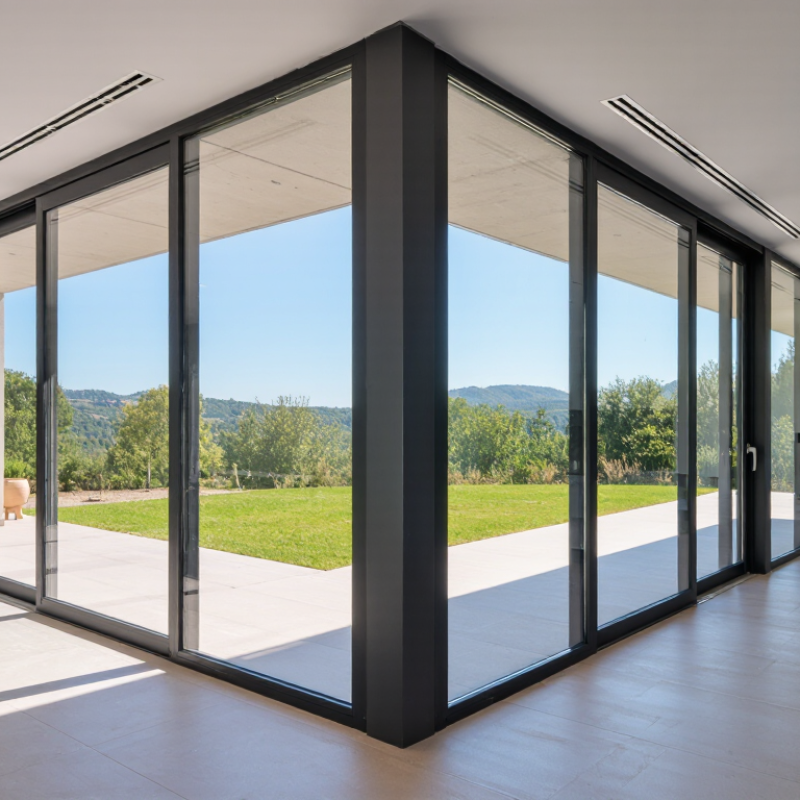
What makes a window or door “long” in modern buildings? There is no universal size threshold. Designers usually mean a wide, low opening, a tall glazed panel, or several units joined into one visual line. The real definition is performance under scale. A 3.6-metre opening can face stronger pressure than a smaller window, especially on a coastal facade. Structural design must check glass thickness, mullion deflection, hardware loads, wind pressure, and installation tolerances. Appearance comes later.
The IEA’s Buildings report, published in 2023, states that buildings use about 30% of global final energy and create roughly 26% of energy-related emissions. Long glazing can improve daylight, but it can also increase solar gain and heat loss. The U.S. Department of Energy reports that windows cause 25% to 30% of residential heating and cooling energy use.
For this reason, buyers should compare U-factor, solar heat gain coefficient, visible transmittance, air leakage, and water resistance. Bigger glass is not automatically better.
For Chinese production, quality begins with project-specific testing, not a catalogue photograph. Request fabrication drawings, glass composition, thermal-break details, and independent test results. Air and water testing should follow recognized standards, such as ASTM E283 and E331, or applicable EN methods.
Installation matters greatly. A small alignment error can weaken an expensive system. I would also question the word “best”: the thinnest sightline may reduce stiffness, while the largest panel may complicate replacement. That trade-off is easy to underestimate.
Which Materials Work Best for Long Windows and Doors?
For long windows and doors, material choice affects strength, insulation, maintenance, and appearance. Thermally broken aluminum is often the most balanced option for wide openings. Its slim frames support large glass panels without feeling visually heavy. The thermal break also reduces heat transfer through the frame. Ask for verified U-values, air leakage results, and water resistance data.
uPVC can provide strong insulation at a lower cost. However, very long frames need reinforced steel sections and careful engineering. Without proper reinforcement, the sash may become difficult to operate over time. Fiberglass offers good dimensional stability and resists warping during temperature changes. It suits large openings, but local availability and fabrication quality may vary.
Wood remains attractive and warm to touch. It needs regular sealing, especially in humid or coastal areas.
I have seen impressive showroom doors perform poorly after installation. The problem was not always the material. Sometimes the opening lacked adequate support, or the glass was too heavy for the hardware. For Chinese-made products, request section drawings, hardware load ratings, coating specifications, and independent test documents. Check the actual corner joints and drainage paths before approving production. A small sample can reveal uneven finishes or weak seals. Long windows need more than attractive frames. They need measured engineering, correct glass, and disciplined installation. I would avoid choosing purely by price, because replacement work can cost more than the original upgrade.
How to Compare Design, Glass, and Energy Performance
When sourcing long windows and doors from China, compare performance before appearance.
In field reviews, a slim frame often looks premium, but weak hardware can distort alignment over time. Measure width, height, opening direction, drainage, and frame reinforcement on the shop drawing. Ask for tested air, water, and structural results, not only catalog claims. The U.S. Department of Energy estimates that windows cause 25–30% of residential heating and cooling energy use. Glass selection is a cost decision.
Compare U-factor, SHGC, visible transmittance, and air leakage in one table.
Lower U-factor usually means better insulation. SHGC needs local judgment: lower values reduce summer heat, while moderate gains can help cold climates. The National Fenestration Rating Council explains that whole-product ratings include the frame, spacer, and glass. Center-of-glass figures can mislead. For a long opening, request full-size testing or engineering calculations. Small samples hide deflection and gasket weaknesses. Test the whole assembly.
Double glazing may suit mild conditions, while triple glazing and warm-edge spacers can improve comfort in colder zones. Low-emissivity coatings, argon filling, and laminated safety glass should match orientation and use. ENERGY STAR criteria provide a useful benchmark through independently verified U-factor and SHGC values.
Ask for certified reports, production tolerances, corner samples, and installation instructions. I would inspect a mock-up after rain and repeated operation.
My comparison sheets are imperfect; delivery damage and installation quality can erase laboratory results. Leave room for that risk.
What Should Buyers Check in Chinese Manufacturers?
Choosing long windows and doors from China requires more than comparing catalog prices. Buyers should examine the manufacturer behind each quotation. Ask how long the factory has produced oversized systems and request photos of completed projects. Check whether the factory controls aluminum cutting, welding, glass processing, and final assembly. In my experience, consistent in-house control usually reduces fitting problems. Still, factory claims need independent verification.
Tips: Request a physical sample corner, not only computer drawings. Test the sliding movement, locking points, drainage holes, and gasket compression. Ask for verified reports covering air leakage, water resistance, wind pressure, and thermal performance. Confirm the testing method and report date. A certificate without matching product specifications may offer little protection.
Review the technical drawing carefully. It should show frame depth, glass thickness, reinforcement, hardware, tolerances, and installation details. Long units can twist during transport or installation, so ask about packaging and lifting instructions. Confirm maximum panel sizes before paying a deposit. Discuss replacement parts and warranty response times in writing. Also check the supplier’s export experience for your climate and building requirements. I once trusted a polished sample too quickly; the drainage design deserved more attention. No checklist is perfect. That is why a pre-shipment inspection remains worthwhile.
What Are the Best Long Windows and Doors from China? - What Should Buyers Check in Chinese Manufacturers?
| Category | Buyer Checkpoint | Relevant Standard or Benchmark | Recommended Evidence from the Manufacturer | Why It Matters for Long Windows and Doors |
|---|---|---|---|---|
| Product Scope | Confirm whether the supplier produces large fixed windows, sliding windows, lift-and-slide doors, folding doors, or hinged doors. | Product type, opening method, maximum tested dimensions, and installation conditions should be stated separately. | Technical datasheet showing tested width, height, area, panel weight, and configuration. | A system suitable for a small window may not perform safely when used in a much wider or taller opening. |
| Structural Performance | Check resistance to wind pressure, deflection, corner strength, and glass load. | ASTM E330/E330M or EN 12210 may be used for structural or wind-load performance, depending on the destination market. | Independent laboratory report identifying the exact frame, glass, hardware, dimensions, and test pressure. | Long frames and large glass panels experience higher bending forces and are more sensitive to deflection. |
| Air Tightness | Verify air leakage through joints, seals, corners, and meeting rails. | ASTM E283 commonly evaluates air leakage at a stated pressure difference, often 75 Pa; EN 12207 provides air-permeability classifications. | Test report with air-leakage results, test pressure, sample size, and classification. | A longer perimeter creates more potential leakage paths, especially at sliding panels and center interlocks. |
| Water Resistance | Check drainage design, sill construction, gaskets, weep holes, and resistance to wind-driven rain. | ASTM E331 or EN 1027 can be used for water-penetration testing; EN 12208 classifies watertightness. | Laboratory report showing test pressure, duration, specimen dimensions, and observed leakage. | Large doors and low thresholds need effective drainage because water can accumulate over a wider sill area. |
| Thermal Insulation | Request the whole-window or whole-door U-value, not only the center-of-glass value. | U-value is expressed in W/m²·K; lower values indicate better thermal insulation. Calculation may follow ISO 10077-1 or NFRC procedures. | Calculation or test report identifying frame, spacer, glass make-up, dimensions, and boundary conditions. | The frame, glass edge, interlocks, and threshold can significantly affect the final thermal result. |
| Glass Specification | Confirm glass type, thickness, coating position, gas fill, spacer, safety treatment, and visible-light requirements. | Safety glazing may be assessed under standards such as EN 12150 for thermally toughened glass or EN 14449 for laminated glass. | Glass configuration drawing, coating details, edge-deletion requirements, and safety-glass certificates. | Oversized panes require correct thickness and safety treatment to control deflection, impact risk, and weight. |
| Glass Safety | Identify locations requiring tempered or laminated safety glass, including doors, sidelights, and low-level glazing. | Local building codes determine where safety glazing is required; EN 12600 is commonly used for pendulum-impact classification. | Glass markings, batch traceability, impact classification, and packing-list confirmation. | Wide glazed doors are frequently located in high-traffic areas where accidental impact is possible. |
| Frame Material | Check alloy designation, wall thickness, thermal-break design, reinforcement, and dimensional tolerances. | The specified alloy, profile geometry, and reinforcement must match the structural calculations and test specimen. | Profile drawings, material certificates, extrusion inspection records, and reinforcement details. | A heavier glass panel cannot be safely supported by a profile or reinforcement arrangement designed for smaller sizes. |
| Surface Finish | Specify powder coating or anodizing type, color tolerance, coating thickness, and corrosion environment. | AAMA 2603, 2604, and 2605 define progressively more demanding requirements for architectural powder coatings; project conditions determine the suitable level. | Coating certificate, color sample, gloss measurement, thickness readings, and pre-treatment records. | Long profiles show color and gloss variation more visibly, while coastal environments increase corrosion exposure. |
| Hardware and Operation | Check roller load rating, locking points, handle operation, anti-lift devices, hinges, and replacement availability. | Hardware must be rated for the actual sash or panel weight and tested for the intended cycle and environment. | Hardware schedule, rated load, cycle-test results, maintenance instructions, and spare-parts list. | Heavy sliding panels can become difficult to operate if rollers, tracks, or adjustment systems are undersized. |
| Acoustic Performance | Request the tested sound-reduction value for the complete assembly, including frame and glass. | Sound insulation testing may follow ISO 10140-2; ratings must be compared using the same measurement method. | Laboratory report stating the complete product configuration and weighted sound-reduction result. | Air leakage at meeting rails and perimeter joints can reduce the acoustic performance of large openings. |
| Drainage and Threshold | Review sill height, drainage channels, accessible-threshold options, end dams, and compatibility with waterproofing. | Threshold and drainage design must comply with the project’s water-management, accessibility, and local building-code requirements. | Section drawings, installation details, drainage diagrams, and site-specific sill recommendations. | A low threshold improves access but may require additional site drainage and weatherproofing measures. |
| Factory Quality Control | Check incoming-material inspection, cutting accuracy, corner assembly, seal installation, glazing blocks, and final adjustment. | A documented quality-management system such as ISO 9001 can support process control, but it does not replace product testing. | Quality manual, inspection checkpoints, nonconformance records, calibration certificates, and production photographs. | Small assembly errors become more apparent and more damaging as the opening size increases. |
| Installation Responsibility | Define survey tolerances, fixing method, perimeter sealing, shimming, sill support, and water-management interfaces. | Installation instructions should be project-specific and consistent with the tested or calculated product configuration. | Approved installation manual, shop drawings, anchor layout, sealant specification, and site inspection checklist. | A well-tested unit can still leak, bind, or deform if it is poorly supported or installed out of square. |
| Compliance Documents | Match certificates and reports to the exact product, configuration, dimensions, and destination-market requirements. | Depending on the market, relevant frameworks may include EN 14351-1, ASTM test methods, NFRC procedures, or applicable national standards. | Traceable test reports, declarations, material certificates, product drawings, and revision-controlled specifications. | Generic certificates may not prove compliance for the actual large window or door being purchased. |
| Pre-Shipment Inspection | Inspect dimensions, diagonals, glass condition, color consistency, hardware operation, labels, packaging, and accessories. | Acceptance tolerances should be written into the purchase specification before production begins. | Signed inspection report, measurement records, photographs, packing list, and serial or batch traceability. | Large units are expensive to return or repair, so dimensional and cosmetic checks are best completed before shipment. |
Note: Performance values should be specified for the exact window or door configuration, dimensions, glass make-up, hardware, and installation method. A standard or certificate alone does not guarantee performance for every product size.
How to Choose, Order, and Install the Right Products
Choosing long windows and doors from China begins with accurate site measurements. Record wall width, opening height, sill depth, and nearby drainage points. Do not measure only once. I once trusted an old drawing and created a costly installation delay.
Ask the manufacturer for complete drawings, frame sections, glass specifications, hardware details, and applicable test reports. Confirm wind-load performance, water resistance, thermal values, and safety-glass requirements for your project location. Local building rules still control the final choice. A technically impressive product may fail if its dimensions exceed elevator, hallway, or lifting limits.
Before ordering, request a physical color sample and a small hardware sample. Check sliding resistance, handle clearance, gasket quality, and finish consistency. Put every agreed detail into the purchase contract, including packaging, replacement parts, inspection stages, and delivery terms. Photos are useful, but they can hide scratches and slight color differences. Consider an independent pre-shipment inspection.
Installation needs equal attention. Prepare a level, square opening with suitable structural support. Long frames can twist during handling, even when packed carefully. Use qualified installers who understand waterproofing, shims, expansion gaps, and frame anchoring. Keep the protective film away from direct sunlight for too long; removal may become difficult. After installation, test each panel, spray the exterior joints with water, and record any adjustment before final acceptance.
Typical Opening Widths for Long Windows and Doors from China
The chart shows indicative planning ranges commonly used for large-opening configurations: fixed panoramic windows, sliding windows, lift-and-slide doors, and folding doors. Actual limits depend on profile depth, glass weight, hardware, wind-load calculations, and local building requirements. Confirm the final dimensions and structural details with the supplier before ordering.
Related Posts
-
2026 Best Long Windows and Doors Types for Your Home?
-
What Is the Difference Between Windows and Doors?
-
2026 Top Trends in Windows and Doors for Modern Home Design?
-
How to Choose the Right Long Windows and Doors for Your Home
-

Top 10 Benefits of Long Windows and Doors for Your Home Design
-
Best Sliding Windows for Global Buyers in 2026?